ACCIDENT DATA REPORTING
A network of
A number of UIAA member federations have established systems to collect data about accidents. Their approaches vary, from gathering of individuals stories for publication, through data collection by online reporting forms to general statistics compiled by the rescue services. Some efforts are community-driven, some organised by climbing federations, and some by public services. Altogether a substantial amount of data is being collected and often put to good use for the benefit of climbing safety, but there is no uniform way of doing it. The UIAA has brought together data and knowledge from the national systems that exist, and created an international database.
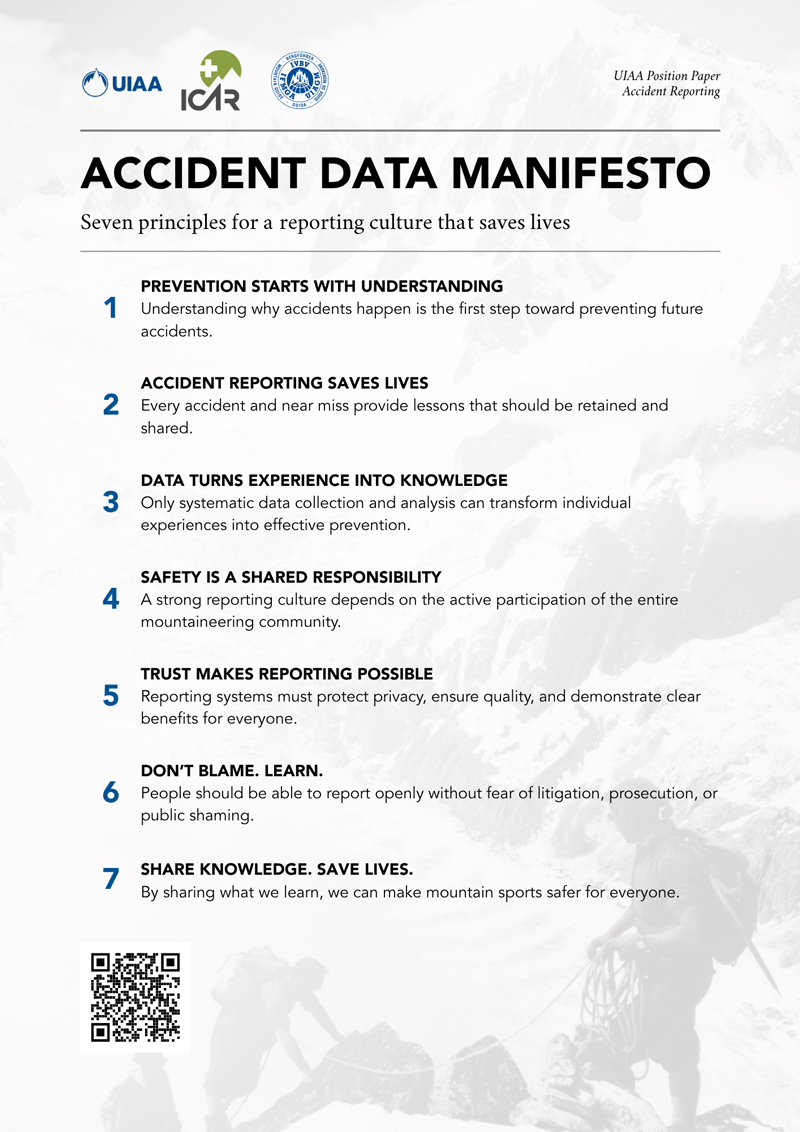
Joint statement
Position Paper on Accident Reporting
In September 2026, the UIAA together with ICAR and the IFMGA published a joint statement, underscoring the importance of fact-based accident prevention. All three organisations encourage national activity representative bodies, insurance companies, professional guiding and tourism organisations, sports associations, rescue services, instructors, guides, and all who cherish safe outdoor pursuits to support and engage with this important work.
The Catalogue of Reporting Systems
The repository of worldwide accident and near miss reporting systems are detailed below. Please note data is correct as of September 2026 and is subject to regular checks and updates.
This catalogue compiles information about existing, national systems and processes for accident and incident reporting relating to climbing and mountaineering. Its objective is to learn about the capabilities of the existing systems, what data they are able to provide, how the data is being used to support climbing safety, their success factors as well as the barriers and obstacles faced in collecting the data.
The UIAA is working on developing recommendations on best practices in accident reporting, and ideally also standards to facilitate data exchange and data comparison between systems.
Relatório de Acidentes (Accident Report)
Brazil • Brazilian Confederation of Mountaineering and Climbing (Confederação Brasileira)
Accidents and incidents registration
Italy • AINEVA / Interregional association for coordination and documentation on issues related to snow and avalanches
| Country | Database Owner | Database Name & Description | Website |
|---|---|---|---|
| Australia | Australian Climbing |
Australian Climbing Accident RegisterLanguage: English Scope: Climbing (general), highlining, caving, canyoning
Analyses/Purpose: A volunteer-only, newly established project to promote open discussion of incidents and near miss events in recreational climbing in Australia. Submissions are elicited from recreational rock climbers within Australia. UIAA description: Public data:
https://rockclimbingaccidents.com.au/database#accident-database/ |
Visit Website |
| Austria | Austrian Board of Trustees for Alpine Safety (ÖKAS) |
Alpine UnfallstatistikLanguage: German Scope: All mountain sports
Analyses/Purpose: The evaluations of the alpine accident database of the ÖKAS and the Alpine Police reflect the accidents in Austria’s mountains, and also developments and trends in mountain sports. Figures, data, facts are the basis for sound accident research and prevention work. UIAA description: Every year, more than 8,000 alpine accidents are recorded by the Alpine Police (BMI) in Austria in the common database. The database records all alpine accidents in which the Alpine Police is involved. Fatal accidents are recorded without gaps. In addition, all reported events in the alpine terrain, regardless of the degree of injury, are recorded. Reporting Results: Statistics, analyses, yearly reports
https://alpinesicherheit.at/unfallforschung/alpine-unfallstatistik/ |
Visit Website |
| Belgium | Belgium, Flemish Climbing Federation |
Klim- en bergsportongevallenLanguage: Dutch Scope: Climbing
Analyses/Purpose: Data are immediately checked in function of insurance. Two times a year a download of the raw data is made. Afterwards, online data are analyzed (and anonymized) by our experts for each discipline we cover. After analysis, they are published on our membership portal. Relevant findings of the analysis are (1) discussed in team (2) discussed with the experts of our clubs for each discipline (3) disseminated in an appropriate way (e.g. newsletter to all member, newsletter to all trainers, social media posts, organization of workshops, adaptation of trainers courses…). A general overview of the findings is published annually in our magazine Monte. Statistics are published annually in our annual report. Data are used as input for our four annual policy plan. UIAA description: The system collects data on accident and near-accidents in climbing and mountaineering. The system is in Dutch and the main target group are the members of KBF and broader, the community of climbers and mountaineers in Flanders, Belgium. Purpose is twofold: members can report an accident for the insurance; data are collected for analysis in function of the policy of KBF (adaptation of courses, promoting certain safety measures or new techniques, inform a broader audience of dangers … Data are anonymized and published. Reporting Results: Public data
https://portaal.klimenbergsportfederatie.be/ongevallen/overzicht-ongevallen/ |
Visit Website |
| Brazil | Brazilian Confederation of Mountaineering and Climbing (Confederação Brasileira) |
Relatório de Acidentes (Accident Report)Language: Portuguese Scope: Climbing (general), canyoning, arborism, professional work
Analyses/Purpose: The aim of the system is to centrally structure information related to incidents and accidents that occur in Brazil in order to stimulate the debate on practices and procedures that can maximize the safety of those involved.
UIAA description: The CBME Accident Reporting Database captures data on incidents and accidents in Brazil. The main data source is anonymous accident reports submitted by observers through an online reporting form. Reports based on media information are also welcomed. The reporting form is based on that of Accidents in North American Climbing. Reporting Results: N/A
|
Visit Website |
| Canada | The Avalanche Canada Foundation |
Mountain Information NetworkLanguage: English, French Scope: Avalanche accidents
Analyses/Purpose: The Avalanche Canada Foundation is a registered charity that supports youth education, community outreach, research, and public safety programs. UIAA description: A system to share avalanche observations, incidents and avalance forecasts. Fatalities, near misses, natural avalanches, skier triggered avlancens and skier remote avalanches are reported. Individuals can also enter their own incidents / observations via the Mountain Information Network Reporting Results: Fatal accidents overview: https://incidents.avalanche.ca/?timeRange=1781%2F1782+-+2025%2F2026&lng=-95.58300000000062&lat=36.45165314924569&zoom=3&view=split_table_map/
|
Visit Website |
| Denmark | Danish Climbing Federation |
UlykkesrapporteringLanguage: Danish Scope: Climbing (general)
Analyses/Purpose: The purpose of the system is to support the Danish Climbing Federation’s work to improve climbing safety. The reports are being used to generate statistics and for specific studies of accident causes. There are separate reporting forms for indoor walls and crag/ice climbing. UIAA description: The Danish Climbing Federation collects accident and near-miss reports to support their work to improve climbing safety. Reports are submitted by individual climbers on a voluntary basis, and stored as text forms. 5-10 reports are filed annually. Reporting Results: Public data (text file, linked from website)
|
Visit Website |
| France | Camptocamp |
Camptocamp / SERACLanguage: English/French Scope: TBC
Analyses/Purpose: SERAC is a database of incident and accident reports, accessible to all mountain sports enthusiasts, on the camptocamp.org website. This database was launched in 2016 in collaboration with the University of Lyon 1, the Petzl Foundation and the Camptocamp community, in order to learn from each other’s experiences, whether they are serious accidents or near-misses. The SERAC database is an experience-sharing platform designed to collect and disseminate individual stories of accidents, but also incidents or critical situations encountered in the mountains, in order to collectively learn from them.
|
Visit Website |
| Germany | German Alpine Club / Deutsche Alpenverein (DAV) |
BergunfallstatistikLanguage: German Scope: Climbing and mountaineering (general)
Analyses/Purpose: Investigate the accident incidence in mountain sports, their causes and characteristics. UIAA description: The German Alpine Club (DAV) has been publishing mountain accident statistics since 1952. Every two years an extensive report on two seasons is published. The data basis is exclusively accidents of DAV members. The data feeds into research and education, and the safety research of the DAV tries to spread sufficient know-how so that mountain athletes can act independently, situation-specifically and risk-consciously. Reporting Results: Yearly statistics reports: Yearly statistics reports
|
Visit Website |
| Germany | German Alpine Club / Deutsche Alpenverein (DAV) |
Kletterhallen-UnfallstatistikLanguage: German Scope: Indoor climbing and bouldering
Analyses/Purpose: Accident reporting which allows us to investigate the causes and effects of climbing and bouldering accidents and to derive important prevention work from them and to publish accident statistics. UIAA description: Database for climbing gyms operated since 2012. We receive voluntary data from climbing gyms under DAV and KLEVER (association of private climbing gyms), which cover most of the climbing facilities in Germany. Reporting Results: Yearly statistics reports: https://www.alpenverein.de/verband/bergsport/sicherheitsforschung/kletterhallen-unfallstatistik
|
Visit Website |
| International | International Slackline Association |
ISA Accident ReportingLanguage: English, Spanish, French, German, Spanish, Portuguese Scope: Slacklining
Analyses/Purpose: Used to develop safety guidelines, gear recommendations, and incident publications. UIAA description: International reporting portal for slackline accidents and near-misses. Reporting Results: Public reports: https://data.slacklineinternational.org/safety/accident-reports/
Statistics: https://www.slacklineinternational.org/accident-reports/
|
Visit Website |
| Ireland | Mountaineering Ireland |
Incident and Near Miss Reporting – IrelandLanguage: English Scope: Climbing and mountaineering (general), hillwalking
Analyses/Purpose: Story telling, and used to inform safety campaigns, publicise reports with good learning outcomes UIAA description: Mountaineering Ireland is using the British Mountaineering Council system for accident reporting, see info below.
|
Visit Website |
| Italy | AINEVA / Interregional association for coordination and documentation on issues related to snow and avalanches |
Accidents and incidents registrationLanguage: Italian Scope: Avalanche accidents
Analyses/Purpose: On a seasonal basis, data on accidents/incidents are presented in terms of as detailed as possible descriptions of their location, dynamic and outcome; snow conditions are normally documented with in situ stratigraphy. The data summary table is updated continuously during the season, and sesonal reports published at the end of the season. UIAA description: AINEVA is the association of the autonomous regions and provinces of the Italian Alps, established to coordinate the initiatives carried out by its member bodies in the field of prevention and information regarding snow and avalanches. Accidents, incidents and avalanche data are registered by regional offices. The objectives are information exchange and dissemination, adoption of common data collection methods, testing of tools and equipment, training of technicians, and publication. Reporting Results: Data summary table: https://aineva.it/incidenti/
Seasonal reports: https://aineva.it/relazioni-stagionali/
|
Visit Website |
| Japan | JMSCA, Japan Mountaineering & Sport Climbing Association |
JMSCA Accident ReportingLanguage: Japanese Scope: Climbing and mountaineering (general)
Analyses/Purpose: Used to design accident prevention measures. Mountain accident investigation reports have been published yearly since 2003. UIAA description: Accident reporting system operated by JMSCA and JWAF.
As of 2024 the system contains in about 5000 reports with 93 categories and 687 items. Its purpose is to support accident prevention and to incorporate accident information in the curriculum for mountain leaders. Reporting Results: Annual analysis reports
https://www.jma-sangaku.or.jp/sangaku/safe_climb/report/ |
Visit Website |
| Netherlands | Stichting Veiligheid Klimsport – SVK |
Incidence rate for climbing and boulderingLanguage: Dutch Scope: Indoor climbing and bouldering in commercial gyms
Analyses/Purpose: With the incidence rate of emergency room injury we aim to map out climbing safety trend within the Netherlands climbing gyms to enable trend measurement for the Dutch climbing sector and establish a reference benchmark to the incidence figures from comparable activities or other countries. UIAA description: Currently, incidence figures of both ER injuries during indoor climbing/bouldering – independent of association membership – and frequency of participation in the specific sport are continuously collected since 2022. SVK translates and publishes the trend of climbing safety within Dutch climbing gyms. Reporting Results: Yearly statistics: https://veiligheidklimsport.nl/publicaties/incidentiecijfer-seh-letsel-klim-en-bouldersport-2023/
|
Visit Website |
| Netherlands | Royal Dutch Climbing and Mountaineering Federation (NKBV) |
KlimongevallenLanguage: Dutch Scope: Climbing & Mountaineering (General)
Analyses/Purpose: Every single reported accident will be investigated. On regular basis we publish summaries per year. UIAA description: Information to come. Reporting Results: Database/Reports:
http://www.klimongevallen.nl/ongevallen/ |
Visit Website |
| New Zealand | New Zealand Alpine Club |
NZAC ReportingLanguage: English Scope: NZAC activities, climbing (general)
Analyses/Purpose: Incident forms and information about reporting are on the club website. The form goes to a central incident officer, who coordinates gathering further information if required, stores and tags the information. It also gets forwarded to our general manager, who does external reporting. In some cases, incident descriptions with key takeaways/learnings get published in “The Climber” (national magazine published quarterly). UIAA description: There has been a growing positive culture of reporting all incidents/accidents/near misses to foster a “just” culture within the club, learning rather than laying blame. Reporting Results: Internal / quarterly magazine
|
Visit Website |
| Norway | Norwegian Climbing Federation |
UlykkesdatabaseLanguage: Norwegian Scope: Climbing, mountain sports
Analyses/Purpose: Internal monitoring; external publication to promote lessons learned; used in investigation of serious accidents. UIAA description: Anonymized publication of submitted accident and near miss reports. The Norwegian Climbing Federation (NKF) aims to collect all incidents in climbing in Norway. This includes both organized activities indoors/outdoors and independent climbing activities for learning purposes. Based on the reports received, NKF issues an annual report that summarizes the past year. Reporting Results: Public data / Annual reports: https://ulykkesdatabasen.no/rapport
|
Visit Website |
| Norway | Norwegian Water Resources and Energy Directorate (NVE) |
Varsom.no / Rapporter skredulykkerLanguage: Norwegian Scope: Avalanche accidents
Analyses/Purpose: Accident prevention UIAA description: The varsom.no accident reporting system is an extended functionality of its public facility to submit observations of avalanches and snow conditions. Results and statistics are generated from the submitted reports and other sources, including public data on fatal accidents. Reporting Results: Statistics/individual reports: https://www.varsom.no/snoskred/snoskredulykker//
|
Visit Website |
| Poland | Polish Cave Rescue Group |
Grupa Ratownictwa JaskiniowegoLanguage: Polish, English Scope: Cave rescue
UIAA description: Detailed chronicle of cave rescue actions. Publicly accessible and continually updated. Reporting Results: Chronicle:
https://grj.com.pl/kronika-wypadkow/ |
Visit Website |
| South Africa | Mountain Club of South Africa |
S.A. Mountain Accidents DatabaseLanguage: English Scope: All mountain sports
UIAA description: Database holding mountain accident and mountain rescue records. Coverage spans broadly between 1890 and present. Total number of records is approximately 3000. Reporting Results: Database:
http://alewis.its.uct.ac.za/sama/sama.php |
Visit Website |
| Spain (Catalonia) | ACNA, Snow and Avalanche Knowledge Association (L’Associació per al Coneixement de la Neu i les Allaus) |
Base de dades d’accidents d’allaus (Database of avalanche accidents)Language: Catalan Scope: Avalanche accidents
Analyses/Purpose: Education and awareness UIAA description: A main objective of ACNA is to reduce avalanche accidents in the Pyrenees and other massifs in Spain. To this end, the accident database brings together information at the massif level and gives an overview by mountain range. The objective of the database is to know where, when and how accidents occur in order to be able to address reduction/mitigation strategies. Reporting Results: Public data: https://www.acna.cat/estadistiques-daccidents/
|
Visit Website |
| Sweden | Swedish Climbing Federation |
Klätterförbundet Rapportera IncidenterLanguage: Swedish Scope: TBC
Analyses/Purpose: Promoting reporting of incidents to provide insights into climbing safety. Reporting Results: Database:
https://www.klatterforbundet.se/category/sakerhet/ |
Visit Website |
| Switzerland | Swiss Alpine Club |
BergnotfallstatistikLanguage: French, German Scope: Mountain sports
Analyses/Purpose: Comprehensive monitoring of mountain emergencies in the Swiss Alps, allowing long term statistical trends to be identified and shared. UIAA description: Detailed annual statistical analysis of mountain emergencies in Switzerland. Reporting Results: Annual reports: https://www.sac-cas.ch/de/ausbildung-und-sicherheit/sicher-unterwegs/bergnotfallstatistik/
|
Visit Website |
| United Kingdom | British Mountaineering Council |
BMC Incident ReportingLanguage: English Scope: Climbing and mountaineering (general), hillwalking
Analyses/Purpose: To improve safety by encouraging climbers and walkers to share their experiences. UIAA description: National incident reporting centre operated by the British Mountaineering Council. Reporting Results: Database:
https://www.thebmc.co.uk/en/incident-reporting |
Visit Website |
| United States | American Alpine Club |
Accidents in North American ClimbingLanguage: English Scope: Climbing and mountaineering (general), incl. ski mountaineering
Analyses/Purpose: Detailed analyses of selected accidents each year with the goal to help climbers avoid similar mistakes. UIAA description: Published annually since 1948 by the American Alpine Club. Contains detailed reports of climbing accidents across North America. Reporting Results: Annual Publication: http://publications.americanalpineclub.org/about_the_accidents
|
Visit Website |
| United States | National Speleological Society |
American Caving AccidentsLanguage: English Scope: Caving
Analyses/Purpose: Each issue of the ACA includes incident summaries based on collected information, along with comments, analyses, editorials and feature articles on caving safety and accident prevention. Readers of the ACA benefit from shared experiences of others, and have the opportunity to learn from those experiences and become safer cavers. UIAA description: ACA serves as an educational resource for cavers and cave rescuers and operates a self-reporting system for caving accidents. Accident reports and statistics are published in an annual report. Reporting Results: Public reports: https://caves.org/american-caving-accidents/
|
Visit Website |
Recommendations for Best Practices
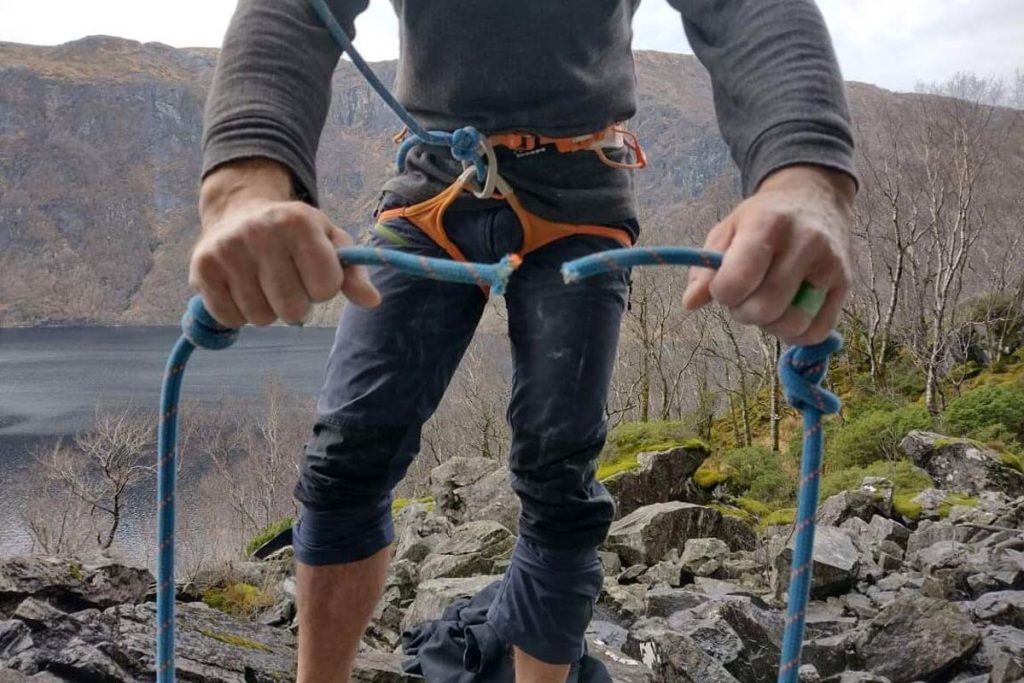
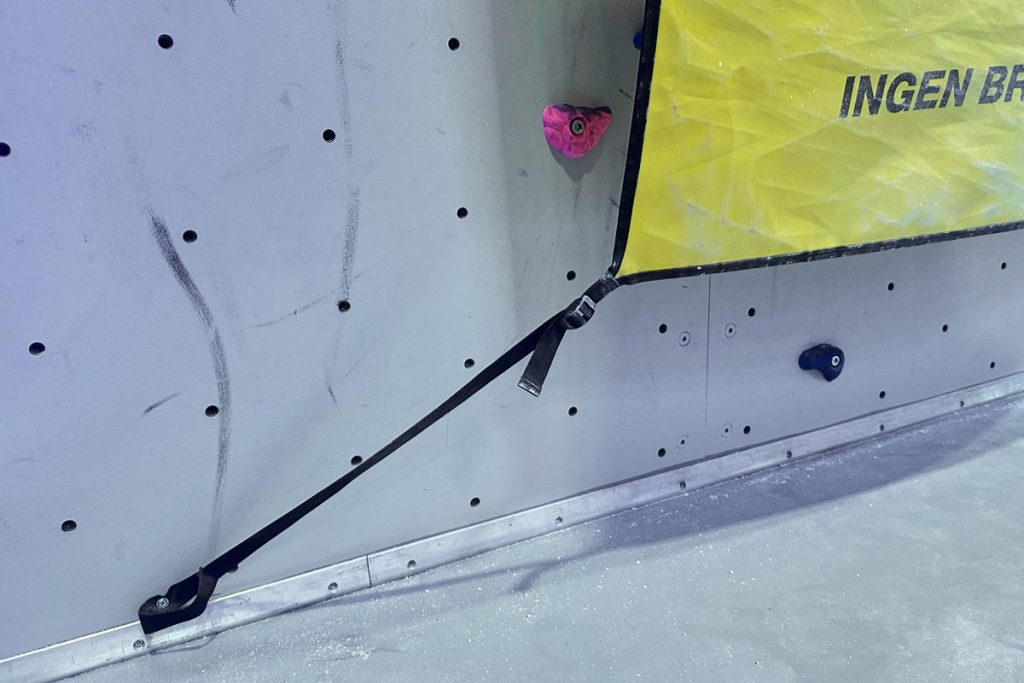
The following case studies related to accident reporting database findings have been published:
Want to share information about an accident reporting system?
Contact the UIAA with details: