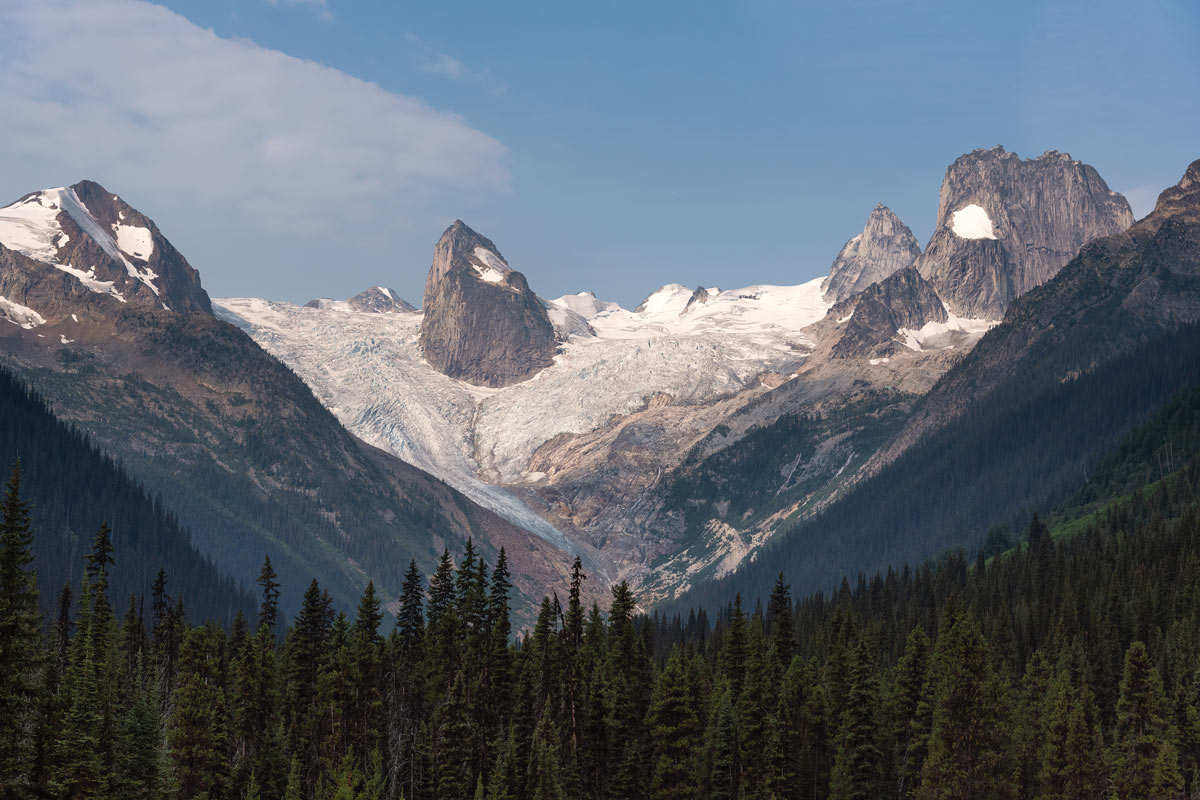
In a newly published book Mountain Voices, alpinists, activists, artists, and mountain researchers share the ways Canadian mountains have impacted their lives. Each contributor brings a unique and fascinating perspective to the mountain landscape with short essays accompanied by a pair of photographs from the remarkable archive of the Mountain Legacy Project, illustrating the history, geography, and lasting inspiration of the mountains.
Mountain Voices draws on the vast bank of historic and repeat photographs produced by the Mountain Legacy Project, the world’s largest systematic and comprehensive collection of mountain photographs, spanning more than a century. From fragile glass plate negatives to modern, high-resolution photography, these images document a mountain landscape during times of drastic change.
Mountain Voices features a diverse array of voices, including Indigenous activists, employees of Canada’s national parks, interdisciplinary scientists dedicated to mountains, alpine adventurers, and historians captivated by tales of mountain pasts. Mountain Voices brings the landscape to life through the passion and devotion of those who love it deeply.
The book is available to purchase here.
About the Editors
Eric Higgs is a professor in the School of Environmental Studies, University of Victoria, and director of the Mountain Legacy Project.
Zac Robinson is an associate professor in the Faculty of Kinesiology, Sport, and Recreation, University of Alberta.
Mary Sanseverino is teaching professor emerita, Department of Computer Science, University of Victoria and Vice President of the UIAA Mountain Protection Commission
Kristen Walsh is a research associate with the Mountain Legacy Project.
Testimonials
The stories are personal and universal. The paired images are humbling. Together they make a profound case for stewardship of these alpine environments.
Carine Salvy, Executive Director, The Alpine Club of Canada
In 1907, the first object of the Alpine Club of Canada was “the promotion of scientific study” of areas then thought to change over eons. After a drift towards emphasized athleticism, mountaineering must return to that prophetic object and, as illustrated in Mountain Voices, bring back from the peaks photographs and stories of rapid and extensive change within mere decades. Mountain lovers, read and see in these pages the changes our modern habits have wrought. Learn. Advocate.
Peter Muir, President, UIAA
Sample Extract
Marvel Lake: Losing Blue
by Leanne Allison
Ice has a memory and the colour of this memory is blue.
—From ‘Underland’ by Robert Macfarlane
We can only imagine how blue Marvel Lake was a hundred years ago. If you stood on Wonder Peak in 1913 and looked at the scene, what would have been most wondrous? The mountains? The glacier? The vast forest? My guess is it would have been the stunning blue of Marvel Lake, a kind of blue that is hard to believe.
Tourists who come to see another, more accessible glacier lake today—Lake Louise—can’t believe how blue it is. They speculate the bottom has been painted or that they put something in the water to make it that colour.
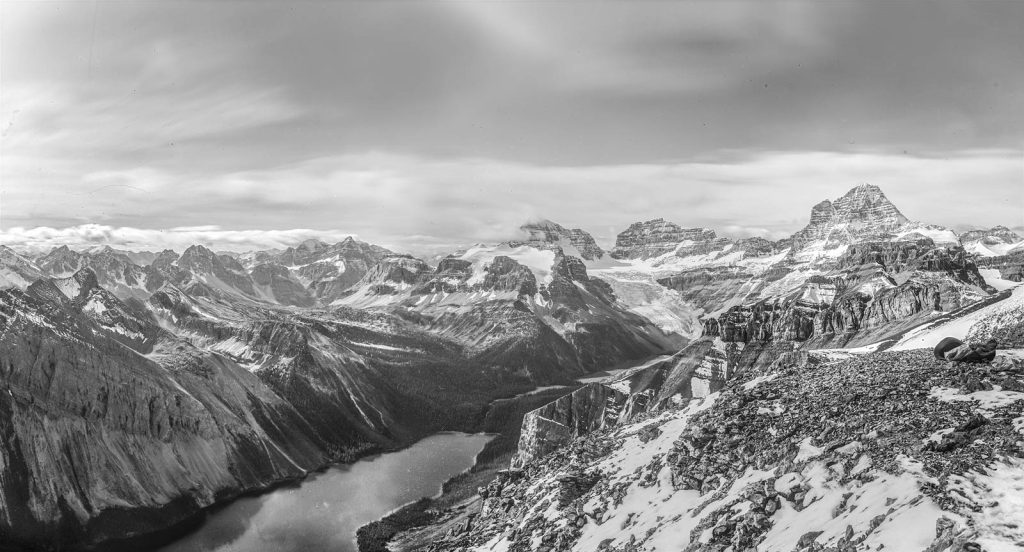
We have so many words to describe blue: powder, baby, turquoise, royal, and some more exotic terms like azure, sapphire, lapis. I saw a poster of Lake O’Hara from the 1990s and was struck by how different it already looks today: A dark and deep blue instead of the jewel blue described by the poster.
What brought me to Lake O’Hara was the chance to meet and learn from limnologists Janet Fischer and Mark Olson. They are studying how less glacier silt, combined with a rising tree line, is leading to a loss of blue. More decayed plant matter, coupled with less silt, altering how sunlight reflects and absorbs light in the water. The end result is a muting of the iconic blue of mountain lakes we’ve come to love and adore.
The most surprising thing about their research so far is how quickly and extensively the change is happening across the Rockies. These lakes are sentinels of climate change: a loss of memory.
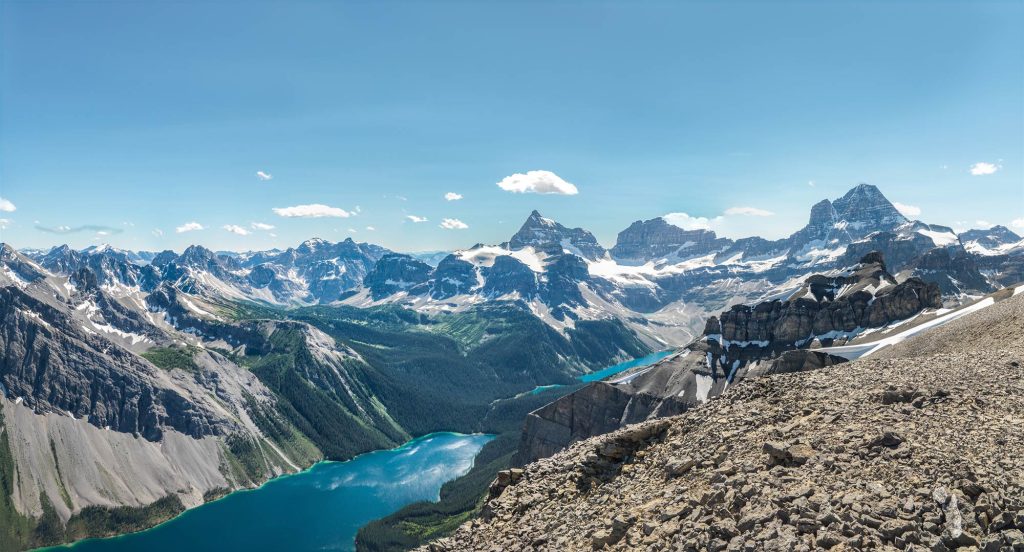
Janet and Mark’s research is tracking this change over a couple of decades and the Mountain Legacy Project’s repeat photography is tracking change over a century. But what if we considered these places in geologic time, before Marvel Lake existed? Before I met Janet and Mark, I had never considered the time scale over which these lakes are born and die. Shifting mountains, receding glaciers, catastrophic rockslides, and volcanoes can all give birth to lakes. But over time all lakes also fill with sediment, get buried, and die. Knowing this makes me feel something in common with Marvel Lake, a kind of vulnerability. It makes me wonder about the lake’s less obvious qualities. How old is she? How did she gain her vitality? And how long will it last?
Are people noticing how she’s changing? Fading? Are there things even she can’t adapt to? Can we take care of her? Can something good come of this? How does this compare to her 10,000 years of life so far?
I’ve always assumed these lakes and their electrifying blue colour would exist forever. But imagine a time when glacier-lake blue is a myth. The story would start, “My grandmother’s grandmother used to climb a mountain called Wonder Peak to take photographs and enjoy the view. She would look out on a lake so blue they called it Marvel Lake.” No one would believe it.
Further Information
Full contents, and purchase the book, here.