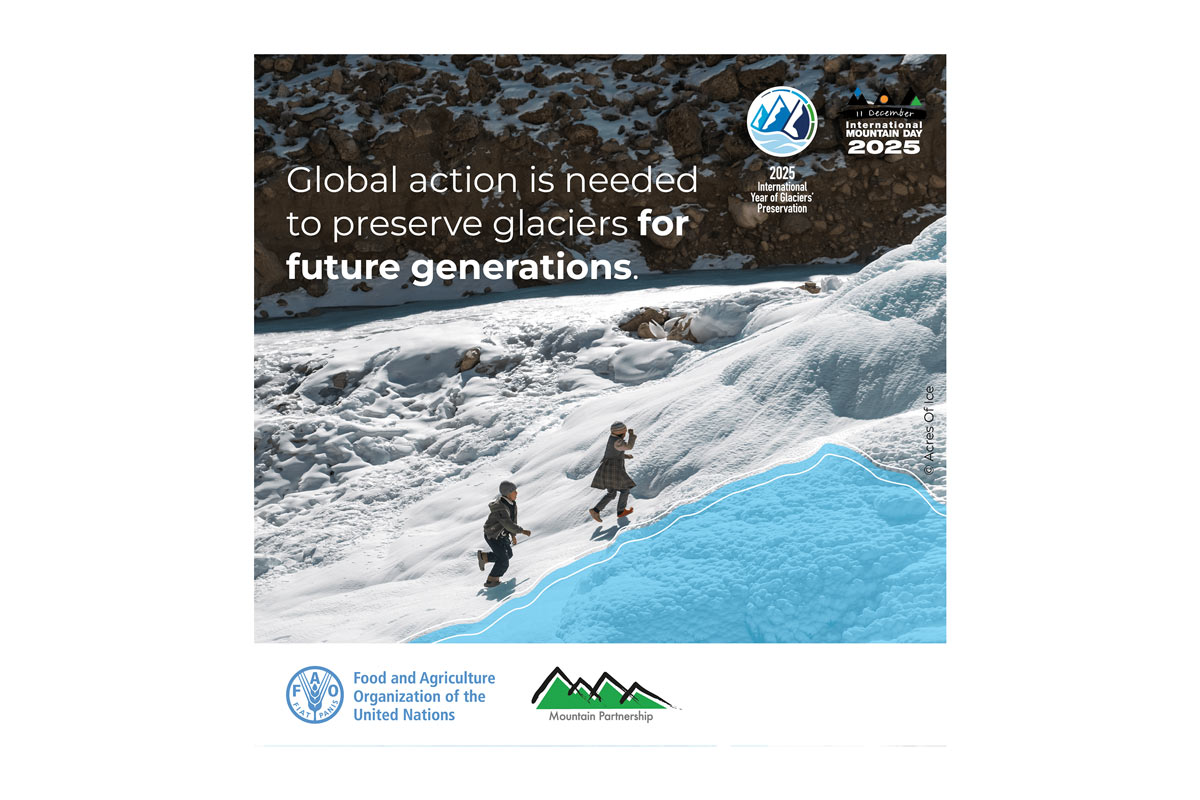
The United Nations General Assembly proclaimed 2025 as the International Year of Glaciers’ Preservation to raise awareness on the vital role glaciers, snow and ice play in the climate system and water cycle, as well as the far-reaching impacts of rapid glacial melt. It aims to promote global collaboration, strengthen scientific research, and promote policies and actions to protect glaciers and cryospheric systems.
Glaciers and ice sheets hold around 70 percent of the world’s freshwater. Their accelerated melting represents not only an environmental crisis, but a humanitarian one, threatening agriculture, clean energy, water security and billions of peoples’ lives. Their retreat, driven by rising global temperatures, is a stark indicator of the climate crisis. Melting glaciers and thawing permafrost increase risks such as floods, glacier lake outburst floods, landslides or enhanced erosion and sediment, endangering downstream populations and critical infrastructure.
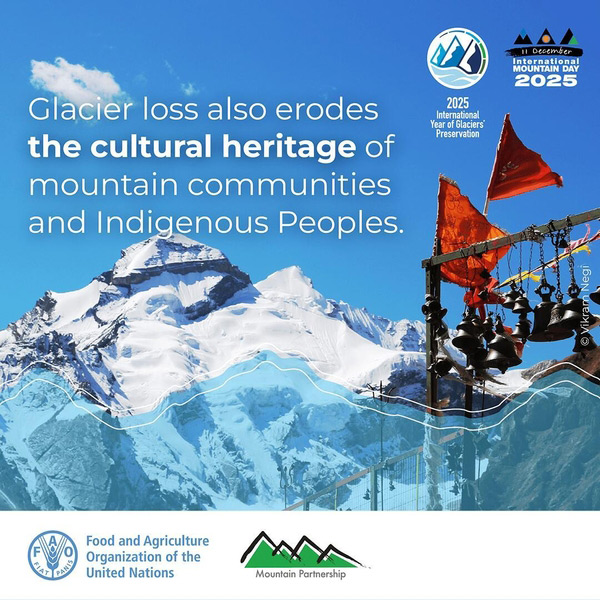
Economically, sectors like agriculture, hydropower, mountain tourism and transportation feel the strain of glacier changes. For many Indigenous Peoples, glaciers are sacred, and their disappearance signifies a loss of identity and connection to nature.
The 2025 IMD theme is:
“Glaciers matter for water, food and livelihoods in mountains and beyond”
The UIAA, International Mountain Day &
Sustainability Actions in 2025
The UIAA Glacier Campaign
The calendar year has been marked by a number of initiatives related to glacier awareness. On 21 March, the inaugural World Glacier Day was observed and on 11 December, International Mountain Day, the theme is “Glaciers matter for water, food and livelihoods in mountains and beyond”. The UIAA produced, and collated, a number of assets related to the International Year of Glaciers’ Preservation including:
In celebration of the UN International Year of Glaciers’ Preservation 2025, the UIAA launched an evocative eleven-part series that brought glaciers – and their urgent climate stories – into global focus. The campaign ran exclusively on the UIAA’s Facebook and Instagram channels. A wrap-up review article provided a summary of the stories and key messages. The series spanned five continents, uniting the voices of scientists, geographers, photographers, artists, mountain guides, climbers and mountaineers, in a sweeping portrait of glaciers as symbols of both fragility and resilience. Each contributor offered a deeply personal and place-based perspective and what the loss of glaciers means for communities, ecosystems, economies, cultures and indeed climbing and mountaineering as activities.
In parallel, the UIAA produced a dedicated Mountain Voices podcast episode titled Glaciers: What Future? which was released on 21 March, the newly dedicated World Day for Glaciers. The episode featured contributions from a number of experts who also provided stories for the UIAA’s glacier campaign.
Letter from UIAA President Peter Muir to UIAA member associations
At the 2025 General Assembly and Climate Action Summit in Peja, UIAA President Peter Muir called on all member federations to take the next concrete step in their own sustainability journey. Building on UIAA’s commitments to halve CO₂ emissions by 2030 and reach net zero by 2040, he has since drafted a letter which will ask each federation to formally submit two things: an overview of its current sustainability and climate-related actions, and at least three new, board-endorsed commitments it will implement in 2026. These should include how progress and success will be measured.
The process is intentionally simple and inclusive, recognising that federations are at different starting points but that steady, modest actions collectively create significant impact. The submissions, due by 31 March 2026, will inform the next UIAA Climate and Sustainability Commitment Statement and help strengthen collaboration, shared learning, and visible leadership across the global UIAA community. The letters will be distributed shortly after IMD.
Glacier preservation is the focus of the 2025 State of the Mountains Report
UIAA member association, Alpine Club of Canada (ACC), recently published its annual State of the Mountains Report for 2025. This latest edition pays hommage to 2025 as the International Year of Glaciers’ Preservation and includes essays by contributors who have spent countless hours researching the alpine environment, offering their firsthand experiences, expertise and photographs to tell the stories of how change in Canadian mountain environments is affecting people and ecosystems.
Read the full story.
Turning climate ambition into climate action: report on the 2025 UIAA Climate Change Summit
The UIAA Climate Change Summit (CCS) 2025, held alongside the General Assembly (GA) in Peja, Kosovo, represented the latest step in the federation’s long-term effort to turn climate ambition into climate action. Starting in Banff in 2022, this was the fourth edition of the CCS, again incorporated within the programme of a GA.
As a logical step following the earlier Summits, this year’s programme shifted its principal focus from awareness-raising toward supporting and promoting practical, member-driven commitments. From a generic but abstract framework for climate action to genuine, concrete actions, each tailored to the capacity and context of individual member associations.
Just as in 2024, the 2025 Summit took place under the slogan “UIAA Climate Action: commit, move, together, now!” , a nod to the central message that the UIAA and its member federations must take collective steps, however small, but consistently and in a coordinated manner. The Climate Change & Sustainability Action List, presented in a poster format, discussed and enriched by the Summits´ participants, now outlines realistic options for member federations at different stages of their climate journey whether beginner, on-the-way, and advanced. It focused on the UIAA’s four pillars: Commit, Mitigate, Adapt and Advocate/Educate.
Read the full story here.
UIAA published annual Carbon Footprint Report
In November, the UIAA released its 2024 Carbon Footprint Report, its seventh in total, and first issued under a new biennial reporting cycle. This update, positioned between the full calculations for the years 2023 and 2025 (to come), reflects a strategic shift towards a lighter methodology and more focused monitoring of the federation’s highest-impact activities.
Read the full story here.
Mountain Voices: Gripping essays from mountaineers, artists and mountain researchers
In a newly published book Mountain Voices, alpinists, activists, artists, and mountain researchers (including individuals working closely with the UIAA) share the ways Canadian mountains have impacted their lives. Each contributor brings a unique and fascinating perspective to the mountain landscape with short essays accompanied by a pair of photographs from the remarkable archive of the Mountain Legacy Project, illustrating the history, geography, and lasting inspiration of the mountains.
Mountain Voices draws on the vast bank of historic and repeat photographs produced by the Mountain Legacy Project, the world’s largest systematic and comprehensive collection of mountain photographs, spanning more than a century. From fragile glass plate negatives to modern, high-resolution photography, these images document a mountain landscape during times of drastic change.
Read the full story, and buy the book, here.
Get Involved
UIAA members are invited to share any initiatives and events they have planned for IMD 2025 with news@theuiaa.org
Join the conversation on social media using the #MountainsMatter hashtag.

Resources
International Mountain Day website
Calendar of IMD dedicated events
11 December Observances
Social Media materials