Category: Training

Jordanian desert climbers hold UIAA Training Standards course

Jordan is the latest country to receive training from the UIAA Training Standards Panel.

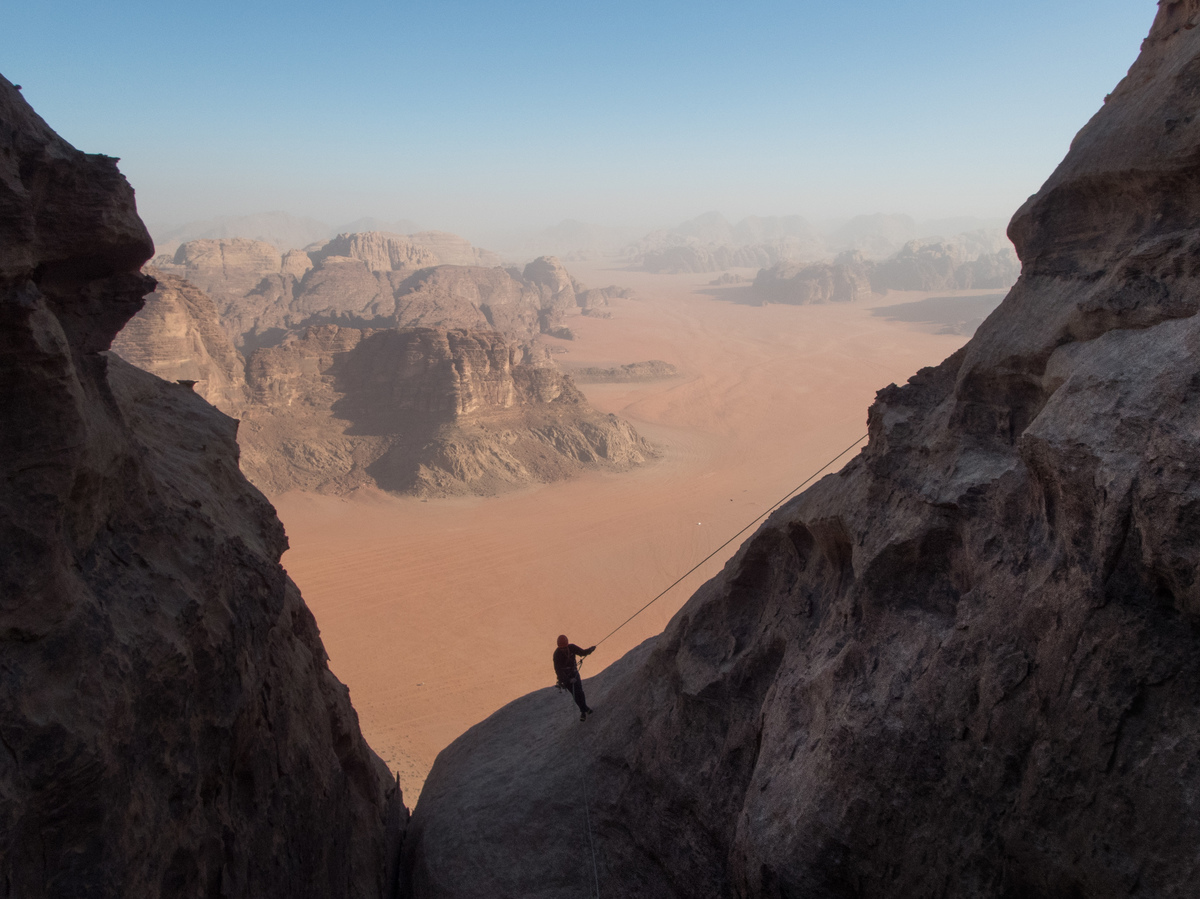
UIAA Training Standards Chair Steve Long reports that three courses were held for the mountain communities of Ajloun, Dana, Karak and Wadi Rum on the request of UIAA associate member Jordan Tourist Board.

The Jordan Tourist Board selected candidates from the local communities for the first round of training course under the direction of Long and a team of trainers from France, UK, Catalonia and Turkey.

Each course lasted a week and took place throughout December.

The training followed a successful induction and site visits in April 2014.

Trainees began working towards creating “entry level” qualifications for mountain activities by providing a series of training courses based on the UIAA standards for hillwalking and rock climbing as well as piloting a training course for canyoning leaders.

Long said the long-term goal is to encourage the development of an association for active participants in mountain activities that can manage these qualifications and accredit trainers and assessors.

“It was evident that trek leader training is a necessary pre-requirement for qualifications in other mountain activities, due to the rugged and arid landscape,” said Long. “The Jordan Tourist Board is now assisting the candidates to organize mountaineering adventures to gain further experience in preparation for assessment and subsequent tutor training.

“It is anticipated that unqualified but experienced leaders from urban areas such as the capital city Amman will also be able to join the programme once the scheme becomes better established,” said Long.

This project was made possible by funding from the Petzl Foundation and will continue in 2015 provided the previous candidates gain suitable experience as recommended in the course debriefs.

Worldwide mountaineering accidents database project gets boost from the Petzl Foundation

The development of a proposed worldwide accidents database run by the Mountaineering Commission has been given a boost from the Petzl Foundation’s board of directors who have agreed to support the project in principal.

The Foundation’s support is contingent on the ability of the Mountaineering Commission, which has been working on developing such a database to cooperate with two French University professors, also supported by the Petzl Foundation, who have been working on a similar project.

To facilitate collaboration, commission member Professor Chiaki Aoyama (Japan), who is behind the UIAA initiative with Mountaineering Commission president Pierre Humblet (Belgium),  met with Professors Bastien Soule and Brice Lefevre at a commission meeting in Brussels in November. The foundation provided an interpreter.

Such a global database, if developed, could help insurance companies better understand risk in mountain activities.

Chiaki said the UIAA which has member associations across the world representing millions of mountaineers is ideally suited to play a crucial role in developing a standardized accident reporting scale for all mountaineering groups.

The project is the brainchild of Chiaki, who has been working on developing an international accident reporting structure for four years and Pierre Humblet who is an insurance specialist lawyer.  It arose out of discussions between the two about the challenges faced by Chiaki during the development of a national accidents database in Japan when they met at a UIAA General Assembly in Matsumoto, Japan.

Chiaki’s problem was his inability to weigh accident characteristic details because of the lack of comparative databases from other countries. He spent almost 6 months travelling in Europe and North America to collect accident data, and although he was able to amass information from about 12 groups, he found it difficult to compare and relate what he had gathered.

Chiaki said the difficulty to find comparative data from around the world for the Japanese database inspired him to design a detailed, comprehensive and standardized international web-based template for gathering data in both a written and an icons model.

“If we can achieve the standardized mountain accident database in the world, we can weigh the characteristics of mountain accidents in each country,” said Chiaki. “The results will save mountaineers life. And it will be used as the credibility of the technique of training standard.”

Among the issues discussed between the experts at the Brussels meeting was the length and detail of the questionnaire and the best way to gather information which could assess the rate of accidents and to identify the chain of events leading to an accident.

Humblet said mountaineering isn’t as dangerous a sport as the public imagines it to be, and that statistics recently gathered was able to demonstrate this point.

“With effective statistics we could reduce the level of insurance premiums,” said Humblet.

The French professors already have agreements with a number of associations in France to gather statistics, but stated that information can be sparse, incomplete, and inconsistent in detail and often unavailable.

Meanwhile Chiaki has also been working to gather data outside Japan and in touch with groups in Europe and North America.

The next step would be for Mountaineering Commission to contact two or three UIAA member federations to test his web-based question forms by the spring 2014. The Mountaineering Commission’s Legal Expert Working Group is also in the process of drafting a contract to facilitate such information gathering. The draft agreement is expected to be finalized in the next few months.

Participants: Pierre Humblet, President – Mountaineering Commission (CMBEL), Steve Long, Chair (TSP/ BMC), Mike Galbraith, (ACC), Patrick Lamarque, (TSP/ FFCAM), Jordi Guell Magrina, (TSP/ FEEC), Chiaki Aoyama, (MountCom / JMA), Christian Frischknecht, (TSP/SAC), Sergey Vedenin, (MountCom /RMF), Lazar Popara (PSS) Jiri Vogel (CzMA) and Seyran Sucu (TDF).

Invitees: Philippe Descamps, Petzl Foundation, Bastien Soule, Lyon University and Brice Lefèvre, Lyon University.

Chile becomes first South American country to become accredited to new UIAA Training Standards

Update: The Mountaineering Commission met in Bavšica, Slovenia in March, 2013 to discuss among other things a training course for sport climbing that was submitted by the Federación de Andinismo de Chile (FEACH). The Training Standards Panel reviewed the proposal and is pleased to report that the course has been accredited by the UIAA – International Mountaineering and Climbing Federation. With the approval, Chile becomes the the first South American country (and Federation) to hold a UIAA Training Label for Sport Climbing.

Editor’s Note: The story which follows was published in in July, 2012.

Training Standards seminar to be held in Chile for first time

The Federación de Andinismo de Chile (FEACH) along with the UIAA Training Standards panel is hosting its first UIAA-approved seminar in South America in the mountains around Santiago, Chile.

The first phase of the training standards seminar (11 – 13 September, 2012) will be held in the Lagunillas, a small resort 67 km southeast of Santiago while the second phase takes place in near nearby El Manzano, known for its towering rock faces and a popular day trip destination for rock climbing.

Topics that will be covered during the sessions includes basic techniques in mountaineering, rappelling and the use of crampons and ice axes. Advanced techniques that will be covered includes shorting roping, snow rescue and a discussion of mountaineering ethics such as bolting.

The UIAA Management Committee, in a bid to enhance a much sought after service to member federations, recently approved a set of proposals for voluntary Training Standards  to be delivered as a professional service.

The call for such a service was rated as the number one priority of member federations in the strategic plan survey in 2011 which outlines a road map for the UIAA until 2016.

With the UIAA Training Label, associations can prove that their training and assessment schemes have been independently examined by a UIAA expert and endorsed by an international panel. This makes it possible for mountaineers from different countries to recognise qualifications.

Training Standards is managed by the members of the Training Standards Panel which falls under the Mountaineering Commission.

Earlier this year the Federación de Andinismo de Chile (FEACH) hosted the UIAA Access Commission meeting in the Rio De Olivares region, near Santiago. The Chilean federation (FEACH) is boosting its engagement in access and environmental issues with a new Ministry of Environmental Law that was established a few years ago to manage sensitive mountain environments.

For more information about participating in the seminar, please contact training@theuiaa.org

New Training Standards program ready for evaluation

An innovative multi-year UIAA Training Standards program conducted in cooperation with the Nepal Mountaineering Association (NMA) is in the final stages of evaluation and will provide a template for a much sought-after service from federation members.

The Nepal program, supported by a charity called the Petzl Foundation, is for a trekking leader training scheme with “train the trainer” courses to be administered by the NMA. Steve Long of the UIAA Training Standards Panel said the model can easily be modified for any the current seven UIAA Standards.

Those standards are accreditation for summer and winter walking, ski-touring, rock (adventure and sport) climbing, ice climbing and high alpine climbing.

“We have a model that we can now take to other countries,” said Long. “That model is to help UIAA federation members design and implement credible training qualification systems to an international standard while being geared towards local needs. These will complement and protect professional qualifications, providing training for volunteers and in some cases a first rung on the professional ladder.”

“Each country has its own special requirements,” said Long pointing out that the UIAA can help federations, particularly those who do not have established training standards, to develop a scheme that works for them as one size doesn’t fit all.

Member priority

A new web portal is under development and will be launched through the UIAA website (old.theuiaa.org) for automation of the process of applying for Training Standards this year.

The call for such a service was rated as the number one priority of member federations in the strategic plan survey in 2011, which outlines a road map for the UIAA until 2016. Long said there has been significant interest from member federations who want similar programs either for straightforward accreditation or for a train the trainer style program.

The Nepal program which involves a range of skills development from rope and knot use, to map and compass navigation, risk management and rescue training began in 2006 but was halted due to internal changes within NMA, and resumed again in 2010.


The program is now at a point where six students who were trainees two years ago are now teaching.

Another 10 trainers are working with the HITT programme (High Impact Tourism Training),  implemented by the Netherlands Development Organisation (SNV), to develop tutor training resources and help cascade trek leader training to trekking agencies in Nepal.

Next steps

“We are almost ready for an independent evaluation of the program,” said Long. He said the NMA is now in the process of developing the assessment infra-structure (logbooks, prospectus etc.) and once that is complete, the UIAA will evaluate the whole scheme before accreditation.

The scheme is aimed to deliver a short intense “sandwich” course wrapped around a trekking season and takes place near Kathmandu. It came about because of an agreement at the 2011 UIAA General Assembly with the Nepal Mountaineering Association and Petzl Foundation to develop a self-sustaining course that would provide a suitable level of technical and practical knowledge for hill-walking activities; to complement the longstanding Basic Mountaineering course developed in partnership with the Alpine Association of Slovenia (PZS).

The Petzl Foundation’s original goal of training professional trek leaders has evolved into a mixed-ability training program to help young mountaineers gain basic hill craft, and more experienced mountaineers to gain practical leadership skills and work as a cooperative team.

Long said that a working party, with the assistance of EC funds, the HITT programme is in the process of developing a tutor training manual for UIAA member federations to use and is also in discussions with organisations in Pakistan and India, advising that this should be managed by the national representative organisation in the UIAA.

The UIAA Training Standards group has offered training and support for rock climbing instructors in recent years and several organisations have been newly accredited from Norway, Portugal and Spain, and more recently an evaluation was made in Chile whose result will be ratified at the Mountaineering Commission meeting in March.

For more information please contact training@theuiaa.org

Management Committee of the UIAA approves new process for validation of training standards

The UIAA Management Committee, in a bid to enhance a much sought after service to member federations, has approved a set of proposals for voluntary Training Standards  to be delivered as a professional service.

The call for such a service was rated as the number one priority of member federations in the strategic plan survey in 2011 which outlines a road map for the UIAA until 2016.

The approval in a recent meeting in Budapest, Hungary, sets in place the groundwork for a process that will see trained experts conduct training  around the world based on the new UIAA approved Training Standards process.

The proposal involves  seven activities including hill walking, rock climbing (adventure climbing), sport climbing, snow shoeing, ski touring and high alpine climbing.

A new web portal will be launched through the UIAA website (old.theuiaa.org) for automation of the process of applying for Training Standards early next year.

The current list of approved validations for members can be found here. The next UIAA led Training Standards seminar will be held in Chile in September 2012.

For more information, please contact  training@theuiaa.org

Further developments on Training Standards label announced

Significant progress has been made on the further development of the UIAA Training Standards label. Also discussed at the recent meeting in Switzerland of the UIAA Mountaineering Commission was traditional climbing and an update to the Legal Experts Working Group document on legal liability. The full report on the meeting is from Phil Wickens, commission secretary:

The UIAA Mountaineering Commission met in Bern, Switzerland, in April. The meeting, which was hosted by the Swiss Alpine Club (SAC-CAS), was very well attended with 20 delegates representing 14 different countries, and included meetings of the Mountaineering Commission’s two working groups; the Training Standards Working Group (TSWG) and the Legal Experts Working Group (LEWG).

Chiaki Aoyama from Japan is developing an international system for collecting and analysing accident statistics. Once in place, this will help to identify areas where safety and training can be improved, and for insurance companies to better understand risk in mountain activities.

The Bolting and Traditional Climbing Working Group is currently in the process of collating national policies, guidelines and publications regarding traditional climbing, and regarding the placement of fixed protection in the mountain and crag environments. The group, which is chaired by Doug Scott, is concerned about the loss of traditional climbing areas, skills and ethics. It aims to formulate an UIAA statement that is recognised internationally, and to establish guidelines, based on existing policies, to assist federations in developing their own policy and guidelines for traditional climbing and the placement of fixed protection.

A lot of interest has been expressed in the Training Standards by developing federations and organisations. In order to expand the work of the Training Standards Working Group, a detailed business plan was drawn up, together with a system for training experts, assessors and trainers. The group proposes that a UIAA Training Standard label be awarded to Federations that meet the UIAA standards, and are currently organizing a series of seminars to train the trainers, assessors and external validators. Philippe Deschamps and Stéphane Lozac’hmeur from the Petzl Foundation charity discussed areas in which they are continuing to assist the TSWG. This currently includes providing help for Asian federations to set up their own national training schemes, and help with the design of training manuals for federations that have none.

Xabier Saenz Ezeizabarrena from Spain has succeeded Renee Hopster as Chair of the Legal Experts Working Group. The group is currently updating its 2002 report on legal liability, which it expects to publish shortly. They have also created a database of the most important cases from Netherlands, Belgium, Spain, Britain, France, USA and Japan, and report a reduction in the already limited significance of waivers in EEC law due to new consumer protection regulations. Future work will include reports on waivers, climbing wall accidents, use of expert evidence, insurance, legal risk assessment and cross boarder employment issues.

Russia has its first UIAA-certified climbing instructors

In the following report, Anna Stolbova of the Russian Mountaineering Federation (RMF) describes the successful conclusion of the first UIAA-certified course for Russian climbing instructors:

Nine candidates successfully completed the training course on Rock Climbing Instructor programme which took place in the Mountaineering Camp Bezengi in the Caucasus region in June 2010.

Organization of the Rock Climbing Instructor Course became possible thanks to the programme of cooperation between the RMF and the UIAA.

The long-term aim of the RMF activities is the development and implementation of the new Russian standard of Mountaineering Instructors’ Training in view of the international requirements.

In spring of 2009 the RMF and the UIAA achieved the agreement on international certification of the Central Instructors’ School (CIS) to meet the UIAA Training Standards requirements.

Ronald Whitehead, the President of the Quebec national mountaineering school in Canada (ENEQ) was appointed to be the curator of the CIS from the UIAA. In summer 2009 Ronald Whitehead took part in the CIS work as a moderator. And at the beginning of June 2010 he ran Rock Climbing Instructor Course for CIS trainers on rock climbing technique.

The Course had the following aims:
– training and graduating the first instructors in Russia to be certified in full equivalence to a UIAA-accredited programme
– development of the Russian standards on training rock climbing technique in CIS on the basis of the UIAA Course
– training young instructors for the future work in the Russian School
– exchange of experience

The course trainers:
Ronald Whitehead is the member of the Training Standards Commission UIAA, ENEQ President
Benoit Waller is ENEQ trainer, Rock Climbing guide by the Canadian system.

During the training process the following aspects were focused on:
1. UIAA Training Standard
2. practical training
3. teaching methodology
4. course feedback

Roman Bryk, a candidate of the course comments on the training process:

“From the very beginning the Canadian trainers precisely stated their position: there are a lot of methods and techniques, but the training will be based only on the UIAA Standards. Russian techniques are different from the UIAA standards in details and peculiarities. So the candidates had to retrain to do many technical elements.
Separately we were taught skills of work with carabiners, ropes, knots, fall factors with their characteristics and etc. Every day from early morning till evening the candidates perfected new techniques, in the evening they made presentations on definite topics, and so it lasted for nine days.”

The final examination consisted of three parts:
1. The written examination
2. The practical examination on methodology (teaching session). Each candidate was asked to teach six beginners one of the techniques: multi-pitch rappel, rope ascent and etc. As the beginners there were women working in the kitchen in the Base Camp.
3. The practical examination on multi-pitch climbing (5b, 5c)

Nine candidates successfully passed the examination.

In 2011 the modules on snow and ice techniques, bolting climbing routes, ski-mountaineering are planned for CIS trainers with the participation of the UIAA experts.

The questions of CIS international certification will also be discussed at the Meeting of Mountaineering Commission UIAA which will be held in Moscow in November 2010.

The RMF thanks Ronald Whitehead and Benoit Waller for their professionalism, proper administration of the project, attentive attitude to the candidates as well as it thanks the UIAA for the assistance in organizing this course.

UIAA outlines cooperation with continental bodies

The UIAA has informed the Pan-American Union of Mountaineering and Climbing (UPAME) of its efforts to recognise continental organisations.

Present at UPAME’s recent General Assembly in Huaraz, Peru (May 29-30) was UIAA Vice President, Jordi Colomer.

The General Assembly formally approved a request to ask the UIAA to recognise UPAME.

José Moreano, speaking in the name of UPAME’s members of the UIAA, said that they wanted to be granted the same fee conditions as developing countries and receive a reduction.

Colomer said a proposal had already been made to the UIAA Board for reductions to be given to some nations.

 Training Standards

Colomer outlined the work of the UIAA commissions and members of the commissions, and spoke about the values of the international organisation. He highlighted the UIAA’s Training Standards adding that the UIAA was planning to hold a course in Chile in the near future.

At the meeting, UPAME delegates approved a proposal to hold the first Skyrunner Championships in in Costa Rica next year.

The 2011 UPAME General Assembly will be held in Panama.

UPAME is made up of national federations from nine Latin American states.

UIAA training standards take on increased importance

Participants from 13 countries have met in Wales to discuss the importance of international training standards and exchanged experiences on developing training programmes.

The UIAA Training Standards Seminar took place from May 5-7 and was hosted by Mountain Leader Training UK and Mountain Centre at Plas y Brenin in Wales.

The seminar focused on the benefits of having  international standards for training schemes and the importance of local knowledge. When a mountain leader or instructor chooses to work in a different country, it is vital that their new employer is aware of the knowledge and skills they already have. If the mountain leader has gone through a UIAA approved  training scheme, employers will not have to assess basic skills, such as rope work. They can then focus on training and assessment of skills and knowledge specific to the new country or locality.

It is of course not possible to develop a training programme that can equip every leader to deal with all possible working environments. A qualified instructor from a land-locked country such as Switzerland might have no sea-cliff experience but will have other transferable skills. They will only have to be informed of  issues that are specific to this new environment,  (in this example tidal awareness would be important).

The delegates also discussed the fact that some countries or regions demand that mountain leaders have specific qualifications or are members of certain professional bodies. This means there are also legal restrictions to cross-border recognition of qualifications. At the seminar, the delegates were able to experience UK climbing, including visits to slate quarries and a sea cliff.  Exploring the quarries underlined the importance of understanding national laws and local by-laws. When mountain leaders from other countries visit Wales they might not be informed of local access rules or laws requiring specific qualifications.

The seminar consisted of a good mix of practical and theoretical sessions. Most delegates made a short presentation on their federation and its approved training schemes. This gave a valuable insight into the various levels of development in mountaineering qualifications and different social backgrounds. Some countries, such as Italy, have developed a training scheme over a very long period, while others, such as Japan, had to develop a training scheme at short notice at the request of the government which had reacted to an accident.

The seminar was attended by 20 delegates from India, Spain, Belgium, Israel, Portugal, Finland, Denmark, Ireland, South Africa, Italy, Canada, Wales and England. In addition, three guest speakers from UK organisations were invited to make short presentations.

The event was organised in connection with the UIAA Mountaineering Commission meeting and the British Mountaineering Council International “trad” climbing festival (May 11-17, 2008).